

Diversification, Innovation and Market Expansion: The Spanish Shipbuilding Industry’s Strategy in the Face of Global Volatility
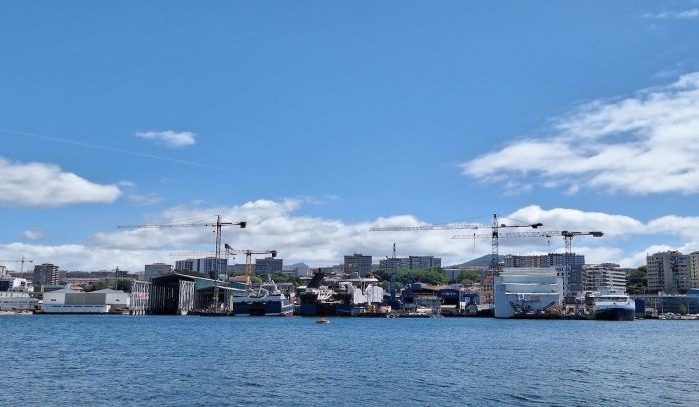
Leadership in high value-added vessels, opportunities in defence and the expertise gained in clean propulsion technologies are among the key factors that have placed the Spanish shipbuilding industry at the forefront of the sector in Europe.
The Spanish shipbuilding industry is currently experiencing one of the strongest periods in its history, driven by record contracting levels over the past 15 years and capacity utilisation of around 80% in key regions such as Galicia. Official data from the Spanish Government show that, at the end of 2025, the industry maintained its commercial momentum after securing 24 new contracts (66,246 GT), adding to an order book worth €3 billion comprising 64 orders and 118,781 GT, 30% more than in the previous year. The industry also has a strong export component: 75% of GT corresponds to vessels for the international market.
The Spanish industry is now reaping the benefits of a clearly defined strategy. Strong strategic diversification towards high value-added vessels — such as oceanographic research vessels and state-of-the-art support vessels for the aquaculture industry — together with technological leadership in the energy transition, particularly in alternative propulsion solutions and vessels for the offshore wind industry, as well as major projects in the promising defence sector, have been key to achieving this strong position, according to representatives of Spain’s leading shipbuilding industry clusters consulted by IP.
“We believe this is a historic moment; the last three years have been extremely strong,” says José Francisco Fernández Aparicio, Secretary General of Pymar, the organisation representing Spain’s small and medium-sized private shipyards. “The Spanish shipbuilding industry is experiencing a positive period in terms of workload and its positioning in high value-added segments,” says Eva Novoa, Soermar’s Managing Director, representing the Spanish industry’s technology centre.
The assessment from Galicia and the Basque Country, two of the main driving forces of Spain’s shipbuilding industry, is similar. “We are experiencing a strong period for new orders because contracting levels worldwide are very high. We are benefiting from that momentum, but we must already be thinking about the next period, from 2028 onwards,” says Óscar Gómez, Manager of Aclunaga, the Galician Shipbuilding Cluster Association. “I don’t know whether this is the best moment in the history of Galicia’s shipbuilding industry, but it is certainly one of them,” says Enrique Mallón, Secretary General of Asime, the Association of Metal Industries and Associated Technologies of Galicia. “I think the current situation is positive; the figures confirm it,” says Sarai Blanc, Director of the Basque Maritime Forum.
However, the current geopolitical situation in the short term, together with the structural workforce challenges facing the industry over the longer term, cast a shadow over this positive outlook. The good news, if there is any, is that this time the industry is facing these circumstances from a position of strength.
GEOPOLITICAL CRISIS: AN INDUSTRY ON ALERT
For a highly internationalised industry that exports between 80% and 90% of its production, whose value chain also depends to a significant extent on imported components, which, despite the progress made, remains closely linked to the fossil fuel market and is highly sensitive to macroeconomic fluctuations, the volatility caused by the conflict in the Middle East represents a direct threat.
The response lies in capitalising on the strengths that have enabled the Spanish industry — and, by extension, the European industry — to lead the sector’s technological and energy transition, while maintaining the strategy that has brought it to its current strong position: diversification across sectors, high value-added projects in emerging segments and a continued focus on the energy transition. Many of the projects currently under construction at Spanish shipyards already incorporate alternative propulsion solutions, ranging from well-established LNG technology to more innovative systems based on hydrogen, methanol or electric batteries. Clean energy is already driving the industry. Spain, for example, has become a European leader and a global benchmark in offshore wind support vessels. All four organisations — Pymar, Aclunaga, FMV and Asime — agree that this is one of the industry’s main market niches and that Spain’s established position, together with the opportunities arising from the future development of offshore wind areas in several countries — including Spain itself — represents a unique opportunity, both because of the expertise gained in component manufacturing and the track record of vessels already delivered or currently on order.
The geopolitical turning point has also positioned the defence segment as one of the industry’s future growth drivers. Research, aquaculture and all passenger-related segments — from low-emission ferries to megayachts — remain strong, alongside the traditional fishing sector, which will also have to undergo its own transition process in the coming years.
An analysis of the order books of Spain’s leading private shipyards — many of which are present at this edition of SMM — is enough to demonstrate not only the industry’s high level of diversification, but also the complexity, innovation and added value of the vast majority of the projects currently under construction, which we examine below.
Source: Industrias Pesqueras